
My Account

Track Order Trade Enquiries

Your Basket

Prices you'll love!
always the best deals
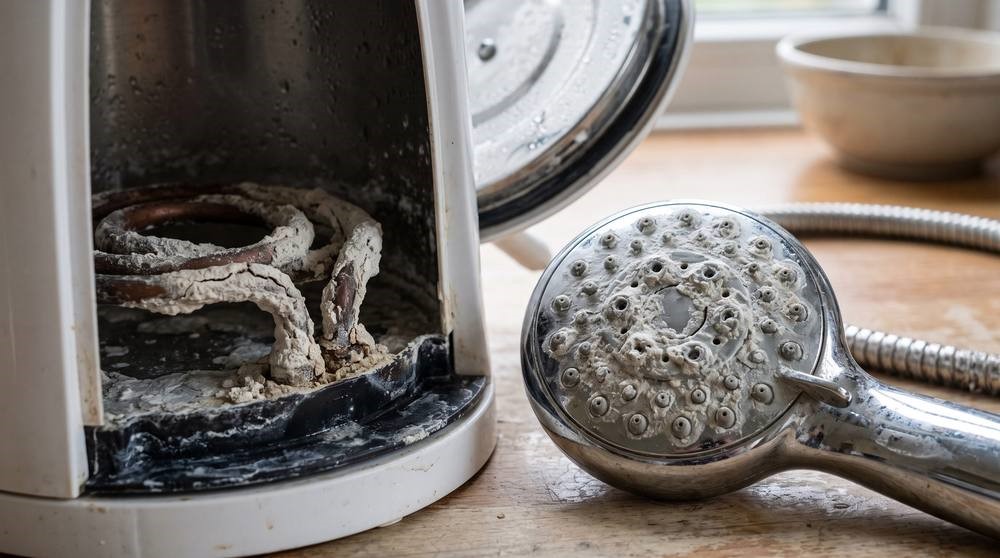
Thick white limescale crusted on the exposed heating element of an opened kettle, with a scaled chrome shower head beside it.

How Hard Is Your Water, and What It Means for Your Appliances

If your kettle furs up within weeks or your dishwasher keeps asking for salt, you have hard water. Here's how to find out exactly how hard, and what's worth doing about it.
Check yours in 30 seconds

Uisce Éireann publishes a lookup that tells you the water type and calcium carbonate content for your own supply, by Eircode or address — check yours on water.ie.

That's the reliable route, and it's worth explaining why rather than just pointing you at it.

Water hardness varies by supply zone, not by county. The water in your tap comes from a specific source: a groundwater borehole in limestone, a surface reservoir fed by upland peat, or a treatment plant blending both. Two houses 15 minutes apart can be on different sources with genuinely different hardness. Dublin is the clearest example, where the answer honestly depends on which zone supplies your street.

So a county map would be tidier and would be wrong for a lot of people. The lookup is right for everybody.

If you're on a private well, the lookup won't cover you — a home test kit or a sample sent to a lab is the way to find out.

What hardness actually is

Hard water is water carrying dissolved calcium and magnesium, picked up as rainwater passes through rock on its way to the source. Limestone and chalk give it up readily; granite and peat don't. The limestone lowlands are the reason hard water is common across a lot of the country, while upland and western surface sources tend to be softer.

It's measured as calcium carbonate in milligrams per litre, sometimes written as ppm.

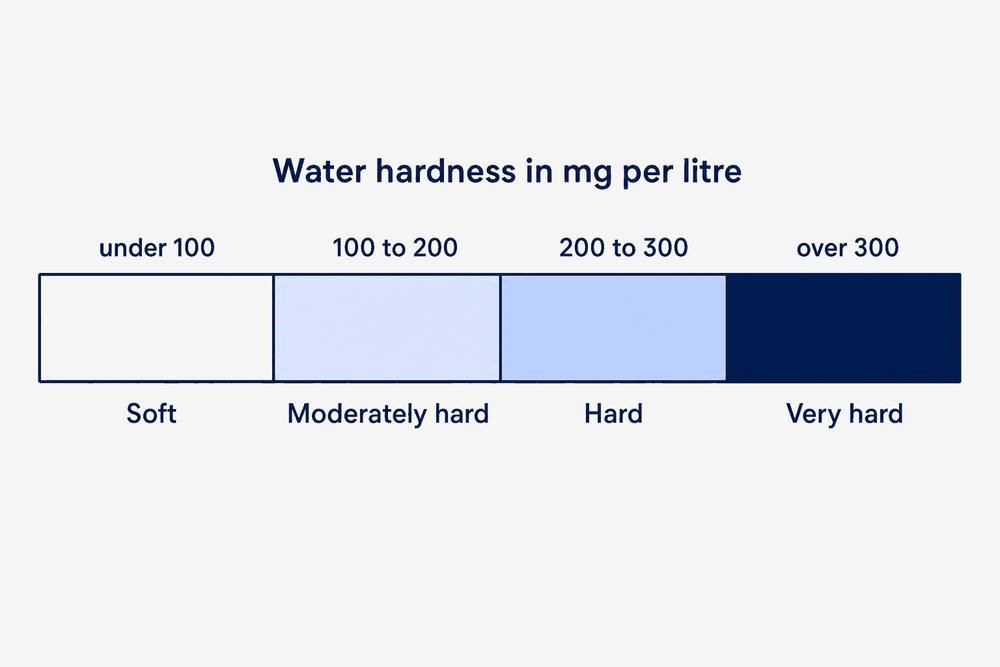
A scale of water hardness in milligrams per litre: soft under 100, moderately hard 100 to 200, hard 200 to 300, and very hard over 300.

Soft

Under 100 mg/l

Soap lathers easily, no scale.

Moderately hard

100 to 200 mg/l

Occasional kettle scale.

Hard

200 to 300 mg/l

Visible scale in weeks, spotted glassware.

Very hard

Over 300 mg/l

Rapid scale, soap struggles to lather.

It's not a health question

Hard water is safe to drink. The Environmental Protection Agency sets no upper limit for hardness in drinking water because it's not a health parameter, and the calcium and magnesium in it are the same minerals people buy in supplements. It's an appliance problem and a comfort problem.

What limescale does to your appliances

When hard water is heated, the dissolved minerals come out of solution and stick to whatever is hot. That's limescale, and it does the same thing everywhere: it insulates a heating element from the water it's supposed to be heating.

Washing machines

Scale forms on the element and inside the pipework. The machine takes longer to reach temperature and uses more electricity to get there. Detergent also works less effectively in hard water, so people compensate by using more, which leaves residue in the drum and creates the musty smell they then blame on the machine.

Dishwashers

The most visible one. Hard water leaves the white film and spotting on glassware that people assume is a broken machine. Dishwashers have a built-in softener for exactly this reason, which is what the salt compartment is for.

Kettles, showers and taps

Kettles are the fastest to show it, and mostly cosmetic, though a heavily scaled element uses more energy for the same boil. Scale blocks shower heads, so the spray goes patchy, and leaves white marks on chrome and glass. In an electric shower it forms on the heating element in the same way as a kettle.

Boiling water taps and coffee machines

These heat water constantly, so they scale faster than anything else in the kitchen, and nearly all of them have a filter or descaling routine specified by the manufacturer. Skipping it is the commonest cause of a warranty conversation.

What to do about it

You don't need to soften your whole house to deal with this. In hard water areas, a maintenance routine handles most of it.

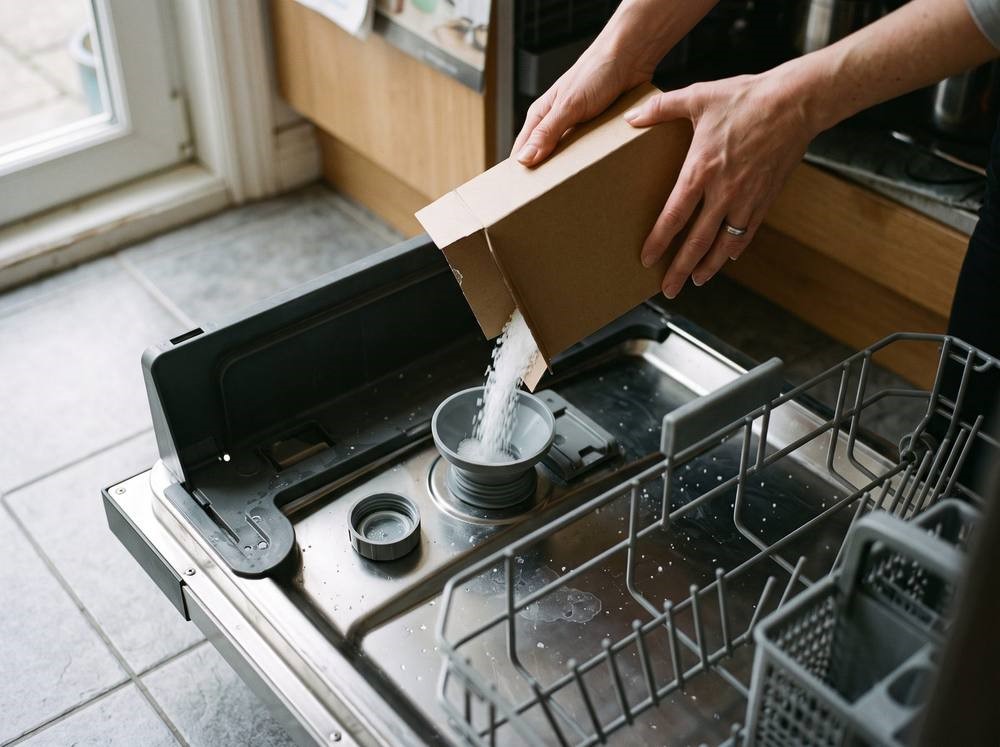
Coarse dishwasher salt being poured into the circular salt reservoir in the base of an open dishwasher.

Set the dishwasher salt level properly

This is the single most useful thing on this page and almost nobody does it. Dishwashers have a water softener built in, and it needs two things: coarse dishwasher salt in the reservoir, and the hardness setting configured to your actual water.

That setting is in the machine's menu or on a dial inside the door, and the manual explains it. Set it from your Uisce Éireann figure rather than leaving it on the factory default. Do that and the white film on glassware usually stops.

Refill the salt when the indicator says so. All-in-one tablets contain some softening agent, but in genuinely hard water they're not a substitute for salt.

Descale on a schedule

Run a proprietary descaler through your washing machine and dishwasher every few months on an empty hot cycle. Check the manual first, because some manufacturers are specific about what they want used.

One thing worth saying plainly: white vinegar gets recommended a lot online, and several manufacturers advise against it because acetic acid degrades door seals and hoses over time. A washing machine cleaner or descaler does the job without that risk.

Descale the kettle monthly and the coffee machine on whatever cycle it asks for.

Keep the small stuff clear

Soak the shower head in descaler when the spray goes uneven. Wipe the shower screen after use, which stops the deposit forming rather than removing it later. Rinse the washing machine's inlet filter, behind the hose connection at the back, if washes start taking longer to fill.

Consider a softener if it's bad enough

A plumbed-in water softener exchanges the calcium and magnesium for sodium and removes the problem at source. It's a real investment with real running costs in salt, and it makes most sense in a very hard water area, in a house with a lot of water-heating equipment, or where scale keeps causing actual failures.

Two things people are rarely told. Softened water isn't recommended for drinking or for making up infant formula, because of the added sodium, so a softener installation should keep one unsoftened drinking tap, normally the kitchen cold tap. And softeners need salt topped up and periodic servicing, so they're a commitment rather than a purchase.

Magnetic and electronic scale conditioners are marketed as a cheaper alternative. The independent evidence for them is mixed, and we'd rather say that than sell you certainty we don't have.

What to look for when buying in a hard water area

  • A dishwasher with an adjustable water hardness setting. Nearly all have one, but check how easy it is to reach, because a setting behind three menu levels is a setting nobody changes.
  • A washing machine with a drum clean or maintenance cycle, which makes descaling a button press rather than a job.
  • Filter availability on boiling water taps and coffee machines. These need filters more often in hard water, so check the filters are stocked and reasonably priced before you buy the machine.
  • A shower head that comes apart for descaling, or one with rubber nozzles you can rub the scale off with a thumb.

Getting help with this

If you know your hardness figure and want to know what it means for a specific machine, our team can talk it through seven days a week. If you're replacing an appliance that has failed early because of scale, we'll take the old one away and recycle it free under WEEE Ireland when we deliver the new one.

Shop our range » Talk to our team

FAQs

Uisce Éireann's water quality lookup returns the water type and calcium carbonate content for your supply zone from your Eircode or address. It takes about half a minute and it's specific to your street, which a county map can't be.

Hard water is common across much of the country, particularly where the water comes from groundwater in limestone. It varies by supply zone rather than neatly by county, and it can differ within a single city, so the Eircode lookup is the only reliable answer for your address.

No. Hardness isn't a health parameter and there's no upper limit for it in drinking water. The calcium and magnesium that make water hard are ordinary dietary minerals. It's hard on appliances rather than on people.

In a hard water area, yes. All-in-one tablets contain some softening agent, but in genuinely hard water they won't keep up on their own. Salt plus the correct hardness setting is what stops the film on glassware.

Every few months in a hard water area, using a washing machine descaler on an empty hot cycle. Check the manual first, as manufacturers can be specific about products, and avoid white vinegar, which several of them advise against because it degrades seals and hoses.

It depends on how hard your water is and how much water-heating equipment you have. In a very hard area with a boiling water tap, a dishwasher, an electric shower and a combi boiler, the maintenance it saves adds up. In a moderately hard area, salt and a descaling routine usually cover it for a fraction of the cost.

Recently viewed


Back to top
