My Account

Track Order Trade Enquiries

Your Basket

Prices you'll love!
always the best deals
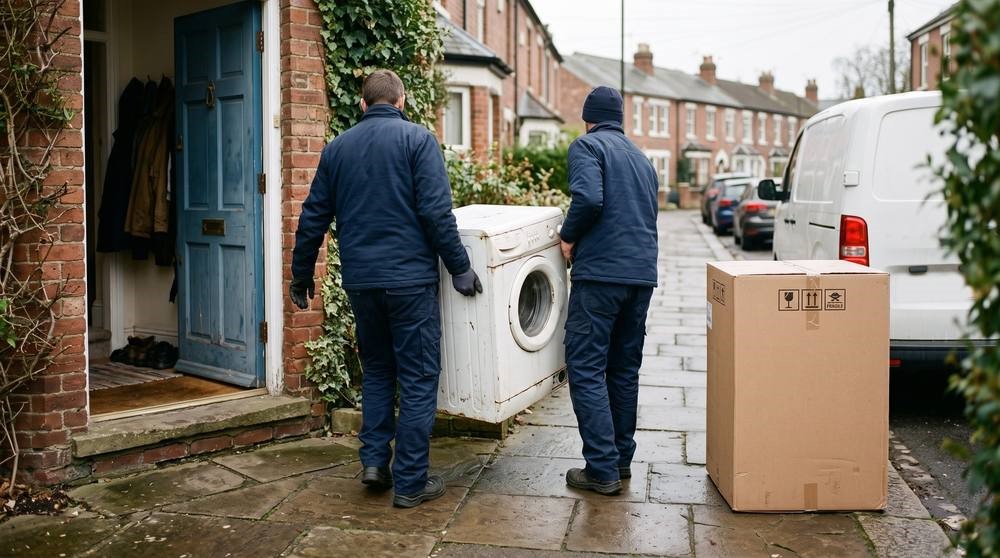
Two delivery workers carrying an old washing machine out through the front door of a terraced house, a new boxed appliance waiting on the path.

What Happens to Your Old Appliance

When we deliver a new appliance, we take the old one away and recycle it, free of charge. Here's how that works and what you need to do to use it.

Free take-back, and the one condition

If you buy an appliance from us to replace one you already have, we take the old one away free of charge on a like-for-like basis. A washing machine for a washing machine, a fridge freezer for a fridge freezer.

There is one condition and it's worth understanding, because it's the thing that goes wrong.

You need notice of the delivery so the old appliance can be disconnected and moved clear before the delivery team arrives. A plumbed-in washing machine can't be lifted onto a van in the 90 seconds a delivery driver has, and a fridge that's just been switched off is still full of food.

The rule for distance sellers is that we give you at least 24 hours' notice of delivery. If we don't, we come back and collect the old appliance within 15 days at no cost to you. Either way you're covered.

What to do before delivery day

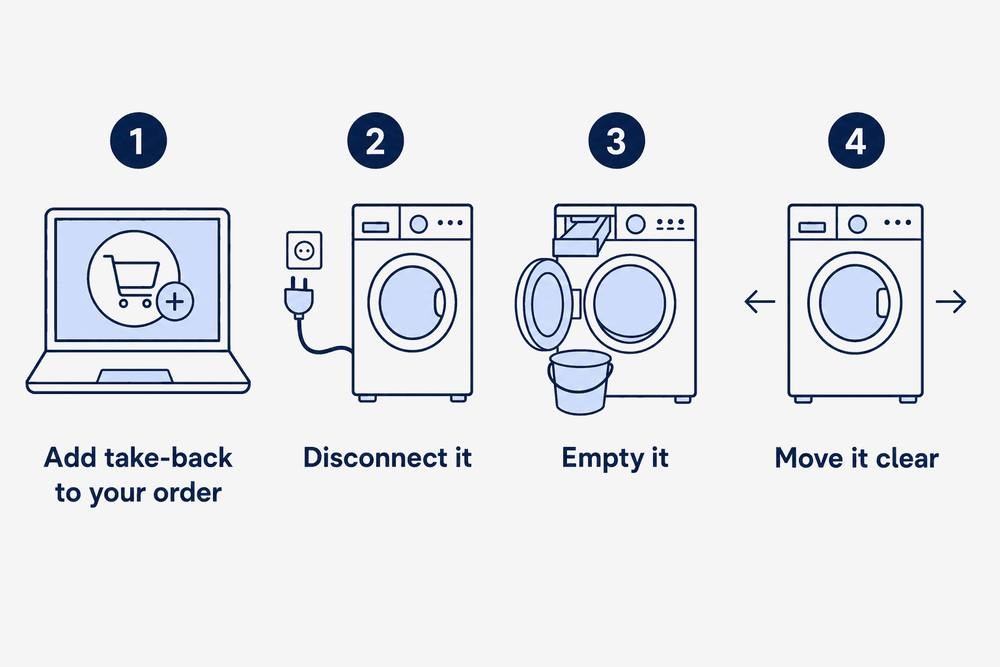
Four steps to prepare an old appliance for collection: add take-back to your order, disconnect it, empty it and move it clear.
  • Disconnect it. Water off and hoses disconnected on a washing machine or dishwasher. Unplugged on everything.
  • Empty it. Fridges and freezers cleared out, and ideally defrosted, which is easier the day before than on the morning.
  • Move it clear of its space if you can, so the route in for the new one is free.
  • Tell us it's coming. Take-back needs to be on the order so the team arrives expecting it.

Batteries: no purchase needed at all

This one surprises people. You can return waste batteries with no obligation to buy anything.

That covers household batteries and the batteries in portable electronics. It's a genuine no-strings arrangement, funded through the same producer responsibility system as the rest of it.

Since 18 August 2025, under the EU Batteries Regulation, distance sellers also have to tell customers about the take-back arrangements at the point of ordering a battery, and to show the collection and treatment costs separately at point of sale.

We collected 1,284 tonnes of portable batteries in 2025 and met the 45% collection target. Vapes are now a meaningful part of that, at 1.4 million devices collected in the year.

The line on your receipt

On some products you'll see a small separate amount labelled as a contribution to recycling costs. The standard wording is "Included in this price is a contribution to recycling costs", followed by the amount.

This is the visible Environmental Management Cost, usually shortened to vEMC. It's not a charge we add and keep. It goes to the compliance scheme that funds the collection, transport and treatment of waste electrical goods nationally, which is what makes the free take-back on this page possible.

It's shown separately on refrigeration, on large appliances, on televisions of 73cm or larger, and on lamps and light sources.

What actually happens to it

Once an appliance leaves your house it goes to an authorised treatment facility rather than a landfill.

There it's depolluted first, which is the important bit. Refrigerants and oils are removed from fridges and freezers under controlled conditions, because the gases in older units are potent greenhouse gases and some are ozone-depleting. Batteries, capacitors and any mercury-containing components come out.

What's left is separated into materials: steel, aluminium, copper, plastics and glass. Those go back into manufacturing.

It works better than most people assume. In 2025 we recovered 82% of the material from what was collected, against an EU requirement of 80%.

How we're doing

Worth knowing, because it's a mixed picture and there's no point pretending otherwise.

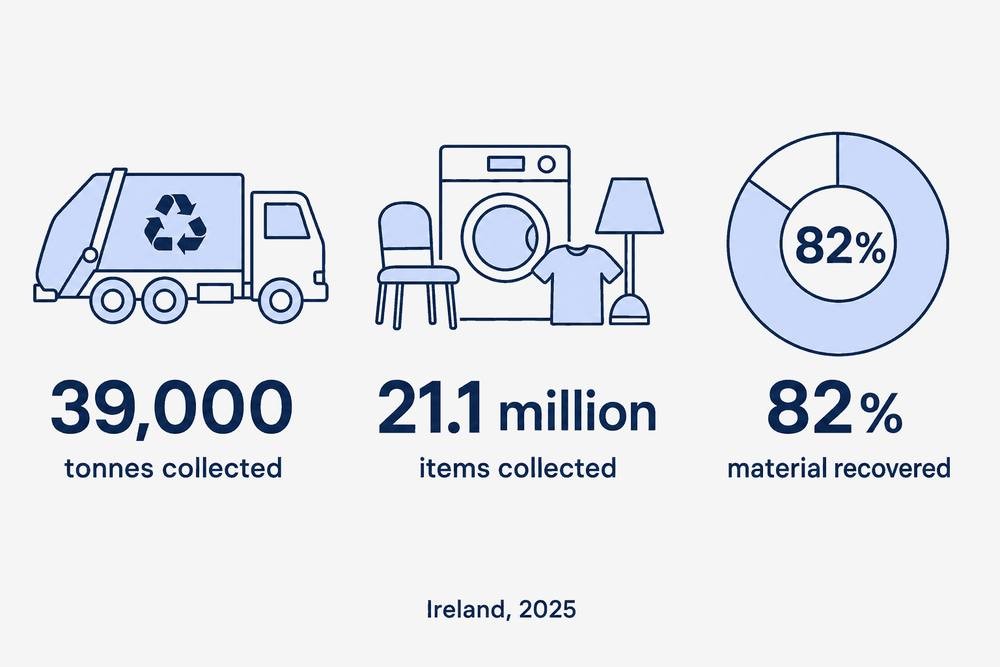
In 2025, 39,000 tonnes and 21.1 million items of waste electrical goods were collected, with 82% of the material recovered.

That included 123,060 fridge freezers and 278,222 televisions and monitors. 84% of counties improved on the previous year.

The part that is less good: we missed the EU's 65% collection target. Not because the system doesn't work, but because a large amount of small electrical equipment never enters it. Old phones in drawers, cables in boxes, a kettle in the attic.

Which is a long way of saying that the drawer is the problem, and it's the one part of this that's entirely within your control.

What we can and cannot take

We can take

On a like-for-like basis with a delivery:

  • Washing machines, washer dryers, tumble dryers and dishwashers
  • Fridges, freezers and fridge freezers
  • Cookers, ovens, hobs and cooker hoods
  • Televisions
  • Air conditioners, dehumidifiers and heaters

We cannot take

  • Anything that is not a like-for-like replacement for what you have bought
  • Anything that has been dismantled or has had parts removed, which authorised facilities will not accept
  • Building materials, furniture and general household waste
  • Anything left inaccessible, in a locked outbuilding or up a flight of stairs it did not come down

For small electrical items with no delivery attached, your local civic amenity site takes them free of charge, and larger electrical retailers take small items back in store. WEEE Ireland runs public collection days through the year as well.

Arranging it

Add take-back to your order when you buy, so the delivery team arrives expecting it. If you've already ordered and forgot, or you're not sure whether your old appliance qualifies, our team can sort it out, seven days a week.

If you're buying an appliance to replace one that has failed early, our guides to what appliances cost to run and how hard your water is are worth a look, because limescale and running cost are behind more early failures than most people realise.

Shop our range » Talk to our team

FAQs

Yes, free of charge, on a like-for-like basis. Add take-back to your order so the delivery team arrives expecting it, and disconnect and empty the old appliance before delivery day.

Yes. As a distance seller we are required to accept your old equipment free of charge on a like-for-like basis when we deliver a new one, provided you have had notice of the delivery. If that notice is not given, we return to collect within 15 days at no cost.

Yes. Battery take-back carries no obligation to buy, and that covers household batteries and batteries from portable electronics.

It is the visible Environmental Management Cost, shown as "Included in this price is a contribution to recycling costs" with the amount. It funds the national collection and treatment of waste electrical goods, which is what pays for the free take-back. It appears on refrigeration, large appliances, televisions of 73cm or larger, and lamps.

It goes to an authorised treatment facility and is depolluted first, with refrigerants and oils removed under controlled conditions because the gases in older units are potent greenhouse gases. The remaining steel, aluminium, copper and plastics are separated and returned to manufacturing.

Your local civic amenity site takes them free of charge, larger electrical retailers accept small items in store, and WEEE Ireland runs public collection days through the year. Small items are where our collection rate falls short, so the drawer of old cables is genuinely worth emptying.

Recently viewed


Back to top