
Staff pricing will be applied on all products. Cha-ching!
Lets GO »Your Basket
What actually matters, in the order it matters, for a home in Ireland.
Most people buy a washing machine in a hurry, because the old one has just failed. This guide is built to be useful in that situation: what actually matters, in the order it matters, for a home here.
Three things about our weather and our housing decide what makes a good washing machine here. Get these right and the rest is detail.
You will dry indoors for a good part of the year. Between 199 and 273 days a year see measurable rain, depending where in the country you are. That makes spin speed one of the most valuable features on the machine, because every extra bit of water it removes is water your airer, your dryer or your dehumidifier does not have to.
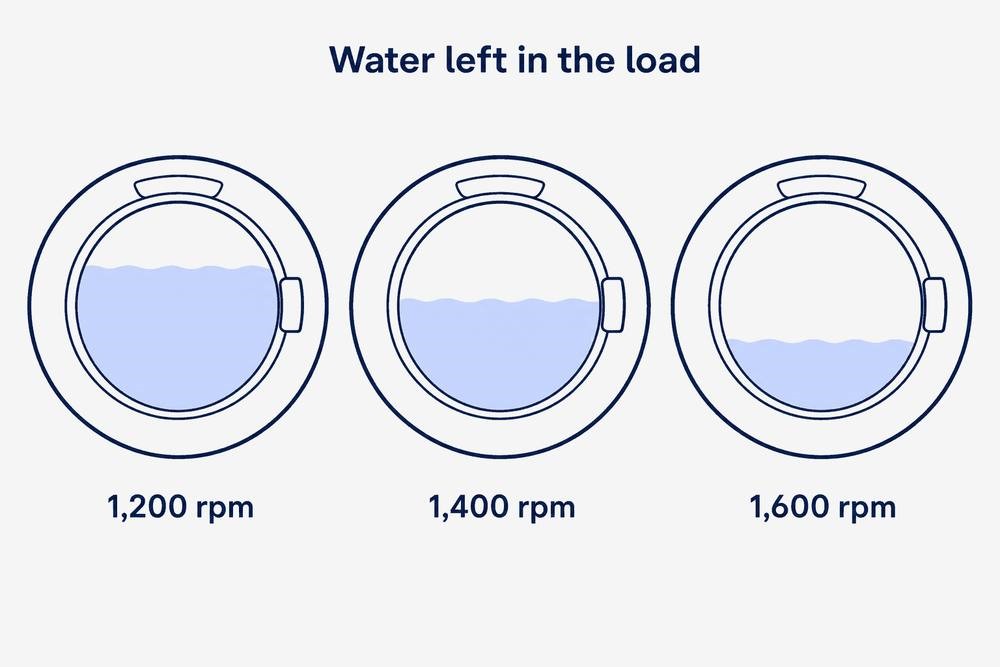
Spin speed is measured in revolutions per minute and it decides how much water is left in the load when the machine stops. A 1,400rpm spin leaves noticeably less water in a load than 1,200rpm, and 1,600rpm less again. Somewhere with reliable outdoor drying, that is a marginal difference. Here, where a lot of laundry finishes on an airer in a bedroom or in a tumble dryer, it changes how long the load takes to dry and what it costs.
There is also a moisture argument. A load of washing dried indoors puts two to three litres of water into the air of your house, and that is the biggest single cause of the condensation that shows up on windows every autumn. A better spin means less of it.
The trade-off is honest: higher spin speeds crease clothes more and are harder on delicate fabrics. Most machines let you drop the speed for a given programme, so buy the higher speed and use less of it when you want to, rather than the other way round.
A practical floor. 1,400rpm suits most households here. Go to 1,600rpm if you dry indoors a lot or run a dryer frequently. 1,200rpm is fine if you have good outdoor drying and a mild spot.
Much of the country has hard water. Water drawn from limestone picks up calcium and magnesium, and when it is heated, that comes out as limescale on the heating element. A scaled element takes longer to heat and uses more electricity doing it. It also means detergent works less well, so people use more of it, which is where the residue and the musty smell come from. If you are in a hard water area, and much of the country is, plan for it rather than discovering it.
The practical routine is short. Run a drum clean or maintenance cycle with a proper washing machine descaler every few months, on an empty hot wash. Check your manual first, because manufacturers can be specific about what they want used. Avoid white vinegar, which gets recommended online constantly and which several manufacturers advise against because acetic acid degrades door seals and hoses over time.
Dose detergent by the instructions rather than by eye. Hard water needs a bit more, but overdosing is what leaves residue in the drum. And check the inlet filter behind the hose connection at the back if washes start taking longer to fill. Mineral deposits collect there.
Features worth having in a hard water area: a dedicated drum clean or maintenance cycle, which turns descaling into a button press, and a machine with an accessible inlet filter.
You can find out exactly how hard your water is from your Eircode in about half a minute, using the lookup on the Uisce Éireann website.
A lot of our housing puts the washing machine in the kitchen rather than a separate utility room, and purpose-built apartments make up a significant share of the stock built since 2001. That shapes three decisions.
In an open-plan apartment, the noise class on the energy label is not a footnote. Look for a machine rated A or B for noise, and for an inverter motor, which is quieter and generally carries a longer motor warranty.
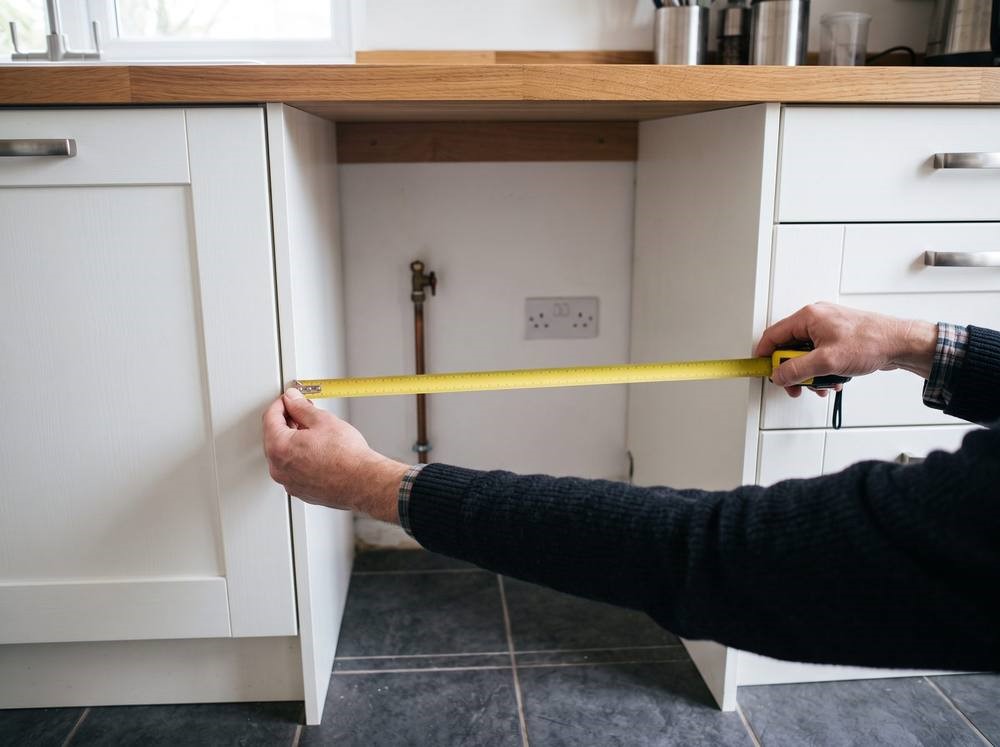
Quiet washing machines »Standard machines are around 60cm wide and 55cm to 60cm deep. Slimline models run 40cm to 45cm deep and lose capacity in exchange. Measure the depth of your space including the door and the hoses behind the machine, which need around 10cm.
Slim depth washing machines »Georgian conversions, upper-floor apartments and narrow terraces all have the same problem, which is the stairwell. Measure the narrowest point of the route, not just the doorway.
If space is genuinely tight, a washer dryer does both jobs in one footprint. It dries less than it washes, so a 9kg washer dryer typically dries about 6kg, and it takes longer than a dedicated dryer. Our washer dryer buying guide covers the trade-off.
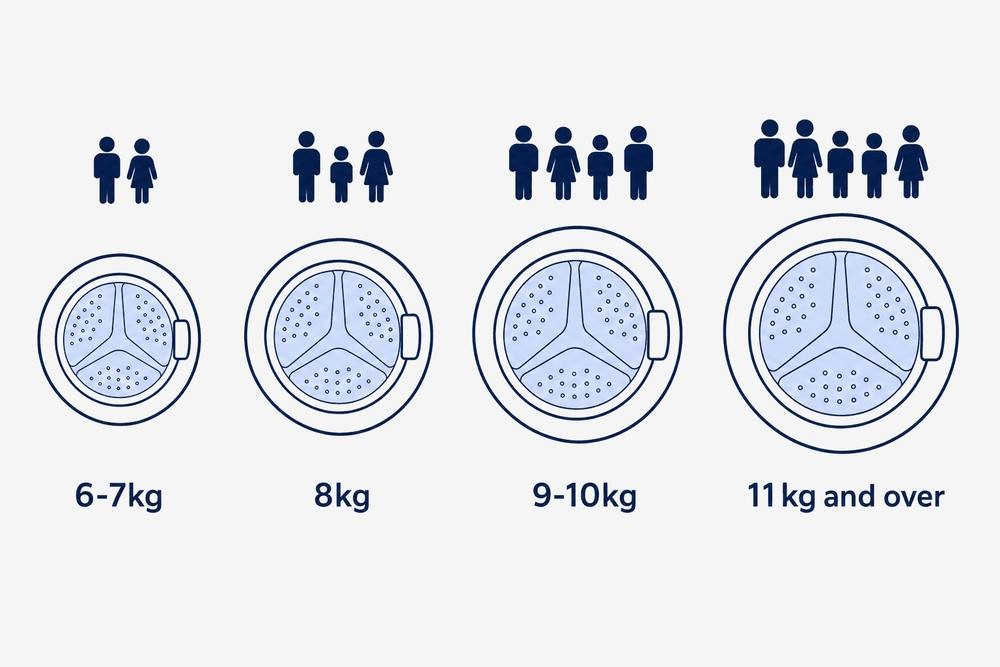
Capacity is quoted as the dry weight of cotton the drum holds. It is the thing people most often get wrong, in both directions.
Buying too big costs you more to run for the same laundry, because a part-loaded machine still uses water and heat, although load-sensing helps. Buying too small means more cycles, which costs more overall and wears the machine faster.
The useful test is not household size, it is what you wash. If a double duvet has to go in the machine rather than to a launderette, you need 9kg or more. If it does not, 8kg covers most families comfortably.
A small family, three or four people. The most common size sold, and usually the right answer.
Shop 8kg machines »The letter is a band, and the number underneath it is the number that matters.
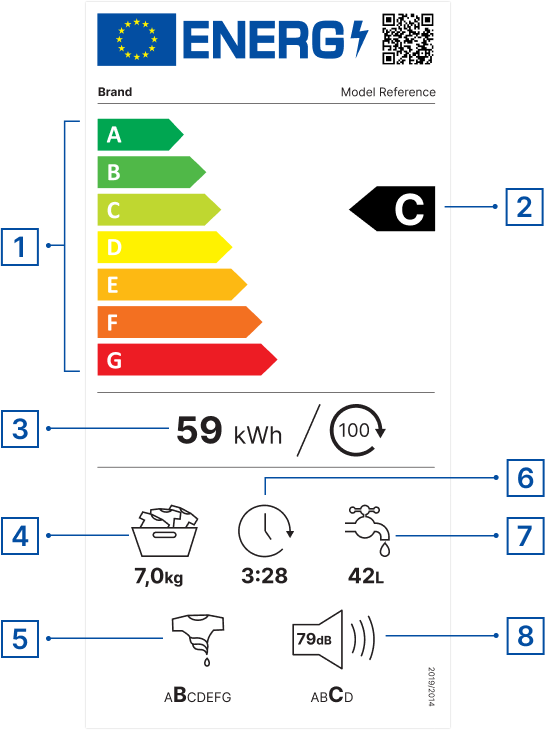
Official EU energy label artwork, European Commission.
1. The A to G efficiency scale.
2. The class this model sits in.
3. Energy use in kWh per 100 cycles, on the standard eco programme.
4. Rated capacity in kilograms.
5. Spin-drying efficiency class, A to G.
6. Programme duration.
7. Water use per cycle in litres.
8. Airborne acoustic noise class.
Washing machine labels quote energy in kWh per 100 cycles on the standard eco programme. Divide by 100 for a single cycle. So a machine quoting 49 kWh per 100 cycles uses 0.49 kWh a wash, which at Electric Ireland's standard rate of 38.04 cent per kWh is about 19 cent, or roughly €39 a year at four washes a week.
Two B-rated machines can differ by several kWh per 100 cycles. That difference, over the eight to ten years you will own it, is often larger than the price gap that made you choose between them.
The pictogram row also gives you water per cycle in litres, programme duration, and the spin-drying efficiency class from A to G. That last one is the spin quality rating, and it is worth reading alongside the rpm figure.
An inverter motor. Brushless, so fewer parts to wear, quieter, and usually carries a longer motor warranty. The most reliable indicator of build quality at any price point.
Load sensing or auto-dosing. Adjusts water and detergent to the actual load. Saves money on every part-load, which is most loads.
A drum clean or maintenance cycle. Essential in hard water.
A delay timer. If you are on a smart meter with a night rate, this is what lets you use it. Night units cost roughly half the day rate.
A quick wash that is actually quick. 15 to 30 minutes for a small, lightly worn load. Useful several times a week.
Anti-allergy or steam programmes if someone in the house wants them, though the claims vary between manufacturers and are worth reading closely.
App connectivity. A small number of people use it after the first month. It is a fine bonus and a poor reason to choose one machine over another.
A very long programme list. Most households use three or four programmes. Twenty of them is a spec sheet, not a benefit.
Very high spin speeds beyond 1,600rpm for general household laundry. The returns flatten and the creasing does not.
Sits on its own, comes in white or increasingly in black or graphite, and is easier to install, move and replace. It is the right answer for most homes and the whole of the rented market.
Freestanding washing machines »Hides behind a cupboard door for a continuous kitchen line. It costs more, holds slightly less for the same external size, and is usually quieter because the cabinet absorbs sound. It also ties you to a decor decision for the life of the kitchen, and a replacement has to fit the same aperture.
Integrated washing machines »If your kitchen is already integrated, stay integrated. If it is not, the premium is buying you a look rather than a better machine.
We pay the highest household electricity price in the European Union. That was 40.42 cent per kWh in the second half of 2025, against an EU average of 28.96 cent, which makes the efficiency gap between two machines worth around 40% more here than it is across the EU on average.
At Electric Ireland's standard rate of 38.04 cent per kWh, an A-rated 8kg machine at four washes a week comes to roughly €39 a year in electricity.
On a smart meter with a night rate of 17.04 cent, the same laundry costs about €17. A delay timer is what makes that possible, which is why it is on the worth-having list above. Do bear in mind that some insurers and most fire services advise against running a washing machine unattended overnight, which is a reasonable point rather than a technicality.
Water, detergent and the eventual repair all sit on top of that.
We deliver nationwide, and we can take your old appliance away for recycling free of charge, in full compliance with the WEEE Regulations. To arrange collection of the old machine, contact us after your new one has been delivered. Full details are on our delivery and recycling page.
Measure before you order: the appliance space, the depth including hoses, and the narrowest point of the route in. That is the single most common cause of a delivery that has to be rebooked.
If you are not sure which machine fits your space or your household, our team can work it through with you, seven days a week.
Every washing machine on our site shows its energy label and its declared consumption figures, so you can do the arithmetic above before you commit.
For most households here, 8kg. One or two people are well served by 6kg to 7kg, and a family of four or five who wash a double duvet at home should be looking at 9kg or 10kg. The useful test is what you wash rather than how many of you there are.
Usually yes. A lot of laundry finishes drying indoors here, and a faster spin leaves less water in the load. 1,400rpm suits most households and 1,600rpm suits anyone drying indoors regularly. Higher speeds crease more, so buy the speed and turn it down when you want to.
An A-rated 8kg machine at four washes a week costs roughly €39 a year at Electric Ireland's standard 38.04 cent per kWh. On a night rate of 17.04 cent, with a delay timer, the same laundry costs about €17.
No, but a dedicated drum clean cycle makes maintenance much easier, and a descaling routine every few months protects the heating element. Avoid white vinegar as a descaler, which several manufacturers advise against because it degrades seals and hoses.
Yes, free of charge and in full compliance with the WEEE Regulations. Contact us after your new machine has been delivered and we will arrange collection of the old one.
The scale was rescaled to A to G in 2021 and the bar was raised deliberately, so an old A+++ machine typically sits at B or C today. A B-rated washing machine in 2026 is an efficient machine. Compare the kWh per 100 cycles figure between two machines rather than relying on the letter.
