
Staff pricing will be applied on all products. Cha-ching!
Lets GO »Your Basket
One of the most common problems in Irish housing, and one of the most fixable.
Our homes sit in air that's close to saturated for much of the year. Relative humidity at 9am averages between 82% and 87% at Met Éireann's stations, and that's an annual average rather than a winter figure. Depending where you live, somewhere between 199 and 273 days a year see measurable rain.
That matters because condensation isn't really about cold. It's about the difference between how much moisture is in the air and how much that air can hold at a given temperature. When air holding a lot of moisture meets a cold surface, it gives some of that moisture up, and the surface gets wet. Warm humid air plus one cold window equals a puddle on the sill.
The housing stock compounds it. Around 33% of dwellings with a published building energy rating sit at D to G, which means colder surfaces and more variable internal temperatures. And research from TU Dublin has put up to 10% of occupied housing at risk of overheating, driven by single-aspect apartments that are difficult to cross-ventilate.
So this isn't a seasonal blip. It's closer to a year-round condition of the building.
The three look similar on the wall and need completely different responses. Getting this right saves you buying the wrong thing.
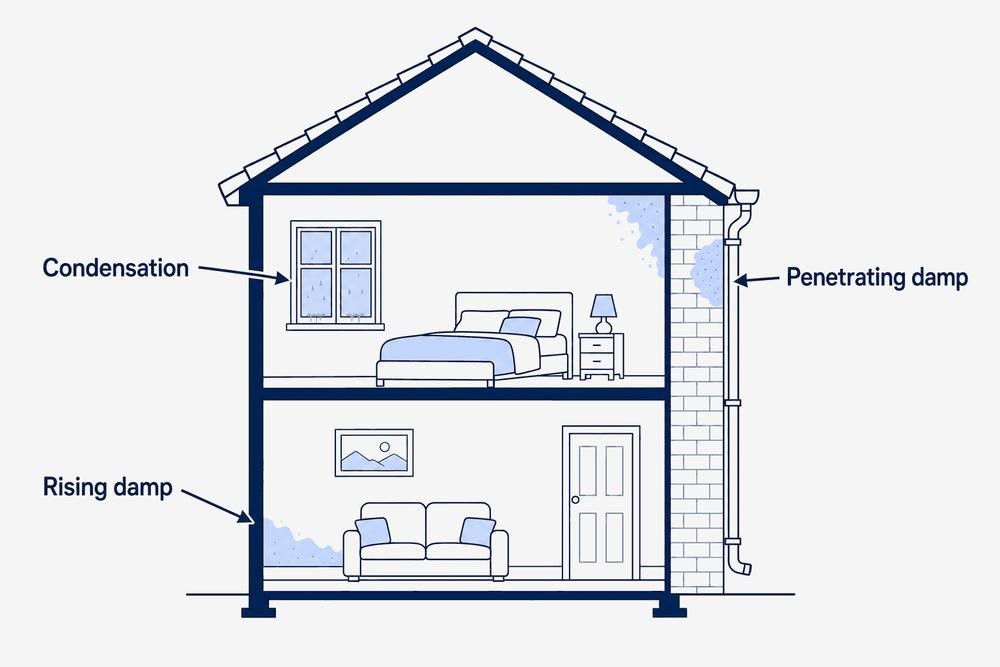
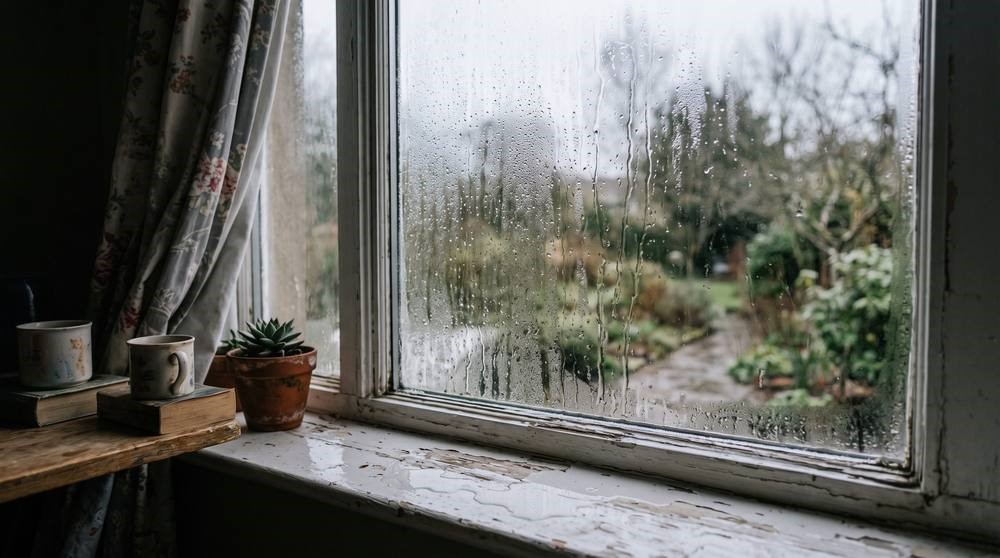
What it looks like. Water on windows and glass, damp patches on cold external walls, black speckled mould in corners, behind furniture, on window reveals and around frames. Worse in the morning. Worse in bedrooms, bathrooms and kitchens.
What causes it. Moisture generated inside the house meeting cold surfaces. This accounts for the large majority of what people call damp, and it's the one you can fix yourself.
What it looks like. A tide mark on a ground floor wall, typically up to about a metre high and no higher, sometimes with a white salty deposit. It doesn't appear upstairs.
What causes it. Groundwater moving up through the wall because the damp proof course has failed or been bridged. A building problem. A dehumidifier will manage the symptoms in the room and won't touch the cause.
What it looks like. A defined patch that gets worse after rain and dries slowly afterwards. Often high on a wall, near a chimney, under a window, or beside a downpipe.
What causes it. Water getting in from outside through a failed gutter, cracked render, a slipped slate or a blocked downpipe. Also a building problem, and usually cheaper to fix than it looks.
Be honest with yourself here. If it's rising or penetrating damp, get a builder or a damp specialist to look at it. We sell things that help with the third one. We'd rather tell you that than sell you a dehumidifier for a broken gutter.
This is the part that surprises people. A household generates a surprising volume of water vapour just by existing.

Typical ranges, not a measured figure for your home — see the note on sourcing below.
Add that up in a four person household and you're putting a meaningful amount of water into the air of your house every day. In a well ventilated, evenly heated home most of that leaves without you noticing. In a house sealed up against the winter and heated in short bursts, it condenses on the coldest surface it can find.
Drying laundry indoors is the biggest controllable source on that list, and it's the one nearly every household does for a large part of the year.
Condensation comes down to moisture in, moisture out, and surface temperature. You have a lever on each.
This one costs nothing. Open bathroom and kitchen windows while you cook and shower, and for a while afterwards, with the door shut so the moist air goes outside rather than into the rest of the house.
Use the extractor fan and let it run on after you leave the room. Keep trickle vents in window frames open, including in winter, because sealing them is one of the commonest ways a well-meaning draught-proofing job creates a mould problem.
Leave a gap between furniture and external walls so air can move behind it. The back of a wardrobe against a north-facing wall is the classic spot for mould nobody sees until they move house.
A short blast of heat in the evening warms the air and leaves the walls cold, which is precisely the combination that produces condensation. A lower, more constant temperature keeps surfaces above the point where the air gives up its moisture.
In a poorly insulated home that advice runs straight into the cost of electricity and heating oil, and we're not going to pretend otherwise. But in the rooms where you're getting condensation, a few degrees of background heat usually costs less than the damage does.
When ventilating and heating aren't enough, or when the weather outside is too wet for opening windows to help, a dehumidifier removes the water from the air directly.
This is where they earn their place. On a mild, wet, still day the outside air holds nearly as much moisture as the inside air, so opening a window achieves very little. A dehumidifier doesn't care what the weather is doing.
The running cost of a dehumidifier is worked out in our guide to what appliances cost to run.
Black mould on a wall is the visible end of a moisture problem, and cleaning it without fixing the moisture just means doing it again in six weeks.
For a small patch, a proprietary mould remover from a hardware shop, used per the instructions on the bottle with the window open and gloves on, will clear it. Wash the cloth afterwards rather than reusing it around the house. Don't brush or vacuum dry mould, because that puts the spores into the air.
If mould covers a large area, keeps coming back in the same place after you've addressed the ventilation, or is on a wall you suspect of rising or penetrating damp, get someone in to look at the building rather than treating the surface again.
Damp housing conditions are associated with respiratory symptoms, and if anyone in the house is affected it's worth raising with a GP rather than with us.
A newly built or newly plastered house carries a large amount of construction moisture that takes months to leave, so condensation in the first winter is common and usually temporary.
Retrofitted homes can see the opposite problem. Insulation and airtightness work reduces the accidental ventilation the house used to rely on, and if the ventilation strategy isn't upgraded at the same time, a house that was cold and dry becomes warm and damp. If you've had a deep retrofit and started seeing condensation you never had before, that's the likely explanation, and it's worth raising with whoever did the work.
If you've worked through the ventilation and the heating and you still have moisture, a dehumidifier is the tool for the job, and our team can help you size one for your home seven days a week. Delivery is nationwide, and if you're replacing an old unit we'll take it away and recycle it under WEEE Ireland.
If what you've described to yourself while reading this sounds more like rising or penetrating damp, get a builder to look at it first. Buying an appliance for a building fault is money spent twice.
Because condensation depends on humidity as much as temperature. The air here is close to saturated much of the year, with 9am relative humidity averaging 82% to 87%, so the air indoors doesn't need to cool very much before it starts giving up moisture on a cold surface.
It removes the condition mould needs, which is moisture, so it helps considerably where the cause is condensation. It does nothing for rising or penetrating damp, where water is entering the building itself, and it won't clean mould that has already grown.
The radiator looks free and isn't. A load of wet washing puts several litres of water into the air of your house, which then has to be heated and ventilated out, and it's the biggest single cause of condensation in most homes. A heat pump tumble dryer or a dehumidifier with a laundry mode deals with the water rather than moving it into your walls.
A 20L compressor model uses roughly 0.35 kWh an hour, so about 13 cent an hour at Electric Ireland's standard rate of 38.04 cent per kWh, or around 80 cent for a six hour run.
Briefly and widely, yes. Opening a window fully for 10 minutes exchanges the air without cooling the walls, which is more effective and cheaper than leaving one ajar all day. Keep trickle vents open all the time.
Condensation appears on cold surfaces, is worse in the morning, and shows up on windows and in corners at any height. Rising damp shows as a tide mark on ground floor walls up to about a metre and never appears upstairs. If it's upstairs, it isn't rising damp.
