Staff pricing will be applied on all products. Cha-ching!
Lets GO »Your Basket
Our homes were built to hold heat in, which is exactly what you don't want in a top-floor apartment in July. What will actually cool your home, what size you need, what it costs to run, and the one legal point that catches people out.
It sounds like an odd thing to write about a country with our weather, and it's a real and growing problem.
Research from TU Dublin has put up to 10% of occupied housing at risk of overheating. The driver is not the climate so much as the building stock. Purpose-built apartments make up a significant share of housing built since 2001, and newer standards have pushed toward smaller units with fewer dual-aspect layouts. A single-aspect apartment with windows on one side cannot cross-ventilate, so once heat is in, opening a window achieves very little.
Add high airtightness and good insulation, which are genuinely good things in February, and you have a building that holds July heat the same way.
That's why air conditioning here isn't the frivolous purchase it's sometimes made out to be. In a single-aspect apartment, a bedroom sitting at 26 degrees at midnight is a sleep problem for several weeks a year, and there's no free ventilation route out of it.
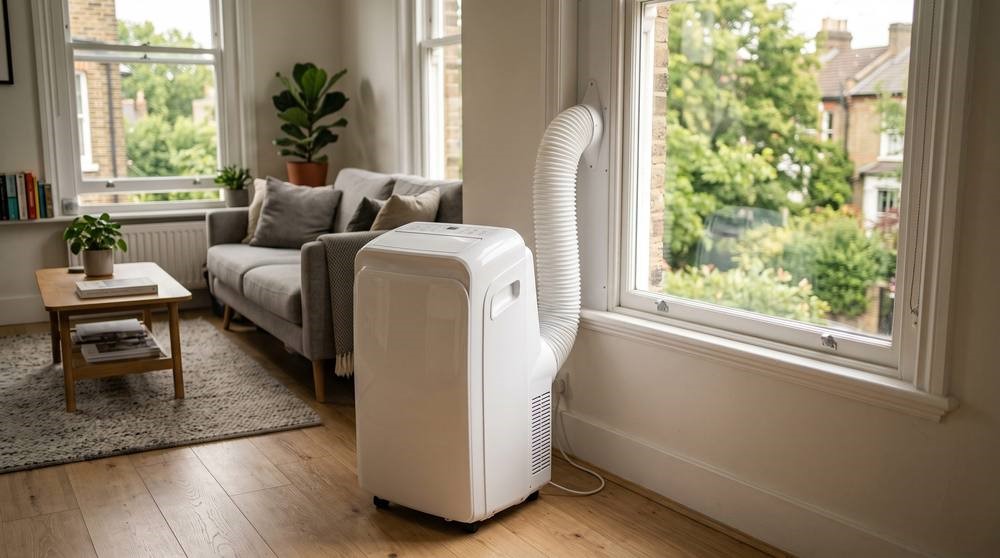
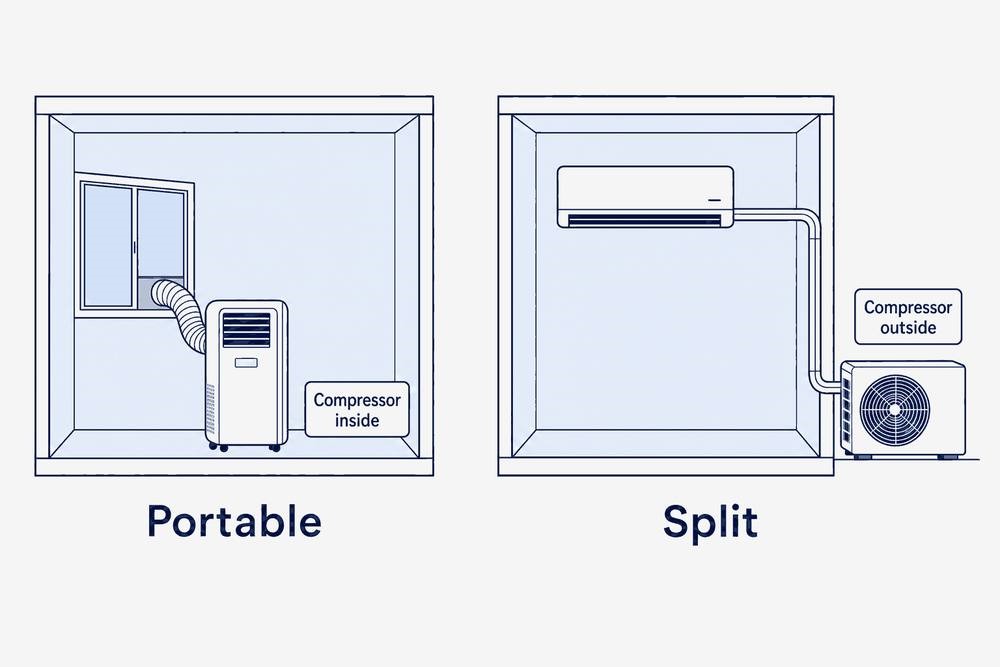
A single unit on castors, with a flexible hose that vents hot air out of a window through a sealing kit.
Suits rented homes, apartments where you can't alter the building, anyone who wants to cool a bedroom for six weeks a year and store the unit the rest of the time, and anyone who wants to buy something today and use it tonight.
The trade-offs. Noisier than a split, because the compressor is in the room with you. Less efficient, because the hose radiates some heat back and the unit draws air from the room it's cooling. And the window has to be part-open for the hose, which costs you some of the cooling you just paid for. A good sealing kit matters more than most people think.
An indoor unit on the wall connected by pipework to a compressor outside.
Suits owner-occupied homes, rooms used all summer, anyone who wants it quiet, and anyone who also wants heating, because most splits are reverse-cycle and heat efficiently in winter.
The trade-offs. It has to be installed, it involves drilling through a wall, and the installation is not a DIY job. It costs more up front and it stays with the house.
Which one, in one line
If you rent, or you can't alter the building, or you need it this week, buy a portable. If you own, will use it every summer, and want it quiet and cheaper to run, a split is the better appliance and the installation is the price of entry.
This is the part we'd rather you knew before you buy.
Working with fluorinated greenhouse gases requires certification. S.I. No. 658 of 2016 makes it an offence to carry out that work without it, and the EPA sets out the certification categories, with training standards developed through QQI. The categories are scoped around the quantity of refrigerant in the system, with thresholds published by the EPA at 3kg, and 6kg for hermetically sealed systems.
In practice: a split system has to be installed by a certified engineer. Connecting the indoor and outdoor units means working on the refrigerant circuit, and that's exactly what the certification covers. Buying a split and installing it yourself is not a shortcut, it's an offence, and it will invalidate the manufacturer's warranty as well.
A plug-in portable is a different proposition. It arrives factory-sealed, there's no refrigerant circuit to join, and nothing about setting one up involves the work the regulations describe. That's the reasoning rather than a published ruling, and we'd rather tell you the basis for it than state it as a certainty. If you want it confirmed, the EPA's ODS and F-Gas team or F-Gas Registration Ltd will give you a direct answer.
Cooling capacity is quoted in BTU per hour, sometimes in kW. Undersize it and it runs constantly without ever getting there; oversize it and it short-cycles, which cools the air without removing humidity and leaves the room feeling clammy.
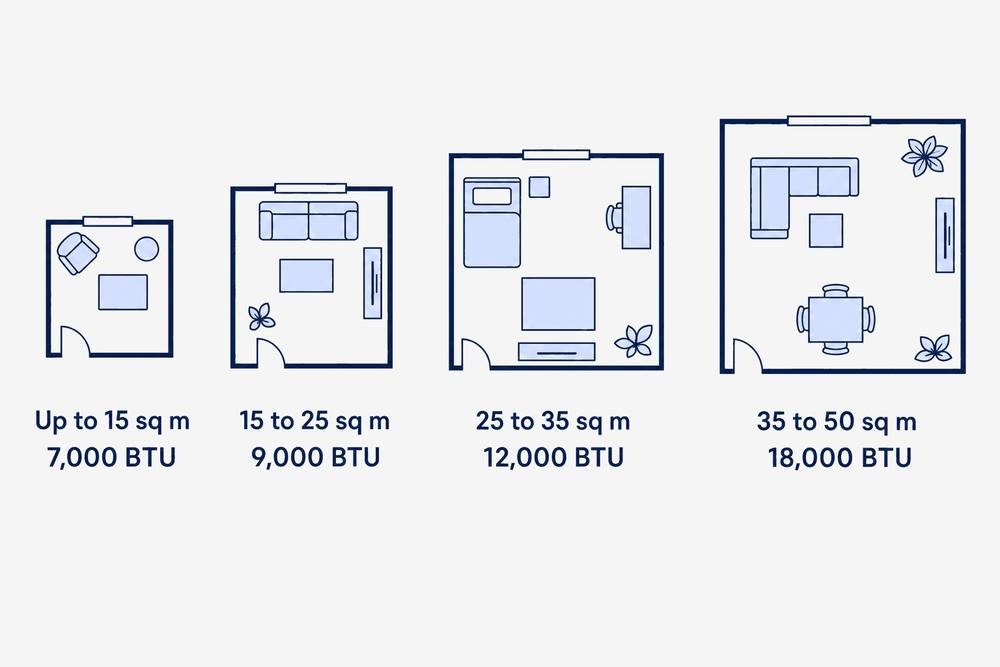
The starting point is floor area.
Then adjust upward for anything that adds heat:
There's a BTU calculator on our air conditioners listing that does this for you.
We pay the highest household electricity price in the European Union, at 40.42 cent per kWh including taxes in the second half of 2025 against an EU average of 28.96 cent. So running cost deserves real weight here.
A 9,000 BTU portable typically draws around 1kW while the compressor is running. At Electric Ireland's standard rate of 38.04 cent per kWh, that's about 38 cent an hour, or roughly €1.52 for four hours. Over a six-week warm spell at four hours a day, somewhere around €64.
A few things pull that number down. An inverter compressor modulates rather than switching fully on and off, so it uses less once the room is at temperature. A well-fitted window sealing kit stops you cooling the outdoors. And a timer or a sleep mode means it's not running while you're asleep and no longer need it.
A split system is meaningfully more efficient for the same cooling, which is part of what you're buying with the installation. Our guide to what appliances cost to run has the method if you want to work it out for a specific model.
Most split systems and a growing number of portables are reverse-cycle, meaning they heat as well as cool. In heating mode they're heat pumps, and they deliver several units of heat for each unit of electricity, which makes them efficient compared with an electric heater.
That matters here for a specific reason. A fixed air-to-air heat pump system attracts an SEAI grant of €7,500. It's worth being clear about what that does and does not cover. The grant applies to a fixed system installed by an SEAI-registered contractor as part of an approved application. A portable doesn't qualify, and a split bought here and fitted privately won't usually qualify either, because the grant attaches to the installation and the installer as much as to the equipment.
If the grant is your reason for buying, start from SEAI's registered contractor list rather than from a product page. Our SEAI grants guide covers the whole scheme.
European F-gas rules are phasing down high-global-warming refrigerants on a published timetable, and it's worth knowing where your purchase sits on it.
Single split systems containing under 3kg of refrigerant have been subject to a GWP-750 limit since 1 January 2025, which is why current stock has largely moved to R32.
For split air-to-air systems of 12kW and under, a stricter GWP-150 limit applies from 1 January 2029 according to the European Commission's own guidance. Split air-to-water systems of the same size reach that limit earlier, on 1 January 2027. Larger systems follow in 2029 and 2033, with a broader phase-out completing in the 2030s and safety exemptions throughout.
What this means for a buyer today is straightforward and not alarming. A unit you buy now is legal, will remain legal, and can be serviced. The timetable governs what manufacturers may place on the market, not what you may own. It's worth checking which refrigerant a system uses, though, because servicing availability follows the phase-down over the long run.
We deliver nationwide. If you're replacing an old unit, we take it away and recycle it free under WEEE Ireland on a like-for-like basis, as long as you have notice of the delivery. Our guide to your appliance recycling rights explains how that works.
If you're unsure whether a portable or a split is right for your room, or what size you need, our team can talk it through with you seven days a week.
For a split system, yes. Working with fluorinated greenhouse gases requires certification, and S.I. No. 658 of 2016 makes it an offence to do that work without it. Connecting a split's indoor and outdoor units is exactly that work. A plug-in portable arrives factory-sealed with no refrigerant circuit to join, so the same requirement does not arise, though no authority publishes a statement to that effect.
Start from floor area: roughly 7,000 BTU up to 15 square metres, 9,000 BTU to 25, 12,000 BTU to 35 and 18,000 BTU to 50. Then add 10 to 20% for large south or west-facing windows, a top-floor room, a kitchen, or high ceilings. The calculator on our listing does the arithmetic for you.
A 9,000 BTU portable drawing around 1kW costs about 38 cent an hour at Electric Ireland's standard rate of 38.04 cent per kWh, so roughly €1.52 for a four hour evening. An inverter model and a well-sealed window kit both bring that down.
Only for a fixed air-to-air heat pump system installed by an SEAI-registered contractor under an approved application, which attracts €7,500. Portable units do not qualify, and a split bought separately and fitted privately will not usually qualify either.
Yes. They work by moving heat out of the room, and the hose is how the heat leaves. Running one with the hose coiled in the room does not cool anything and adds heat from the compressor. A well-fitted window sealing kit makes a real difference.
Yes. The phase-down governs what manufacturers may place on the market rather than what you may own or continue to use, and existing systems can be serviced. It is worth checking which refrigerant a unit uses, since servicing availability follows the timetable over the long term.