
Staff pricing will be applied on all products. Cha-ching!
Lets GO »Your Basket
Worked at current Irish rates, with the arithmetic shown so you can check it against your own bill.
We pay the highest household electricity price in the European Union. In the second half of 2025 it was 40.42 cent per kilowatt hour including taxes, against an EU average of 28.96 cent, which put us first of 27 member states.
That changes the shape of the decision. A running-cost figure worked at the European average is roughly 40% short of what the same appliance costs to run here. Over the eight or ten years you own it, that gap is often larger than the difference in purchase price between the model you were looking at and the more efficient one you talked yourself out of.
The practical version: the sticker price is a smaller part of the decision than it looks, and the label is a bigger part.
Everything below is worked at Electric Ireland's standard residential rates from 1 July 2026, including VAT. If you're with a different supplier or on a different plan, swap your own unit rate into the method below and the arithmetic still works.
Standard 24-hour: 38.04c/kWh, all day every day on a standard plan.
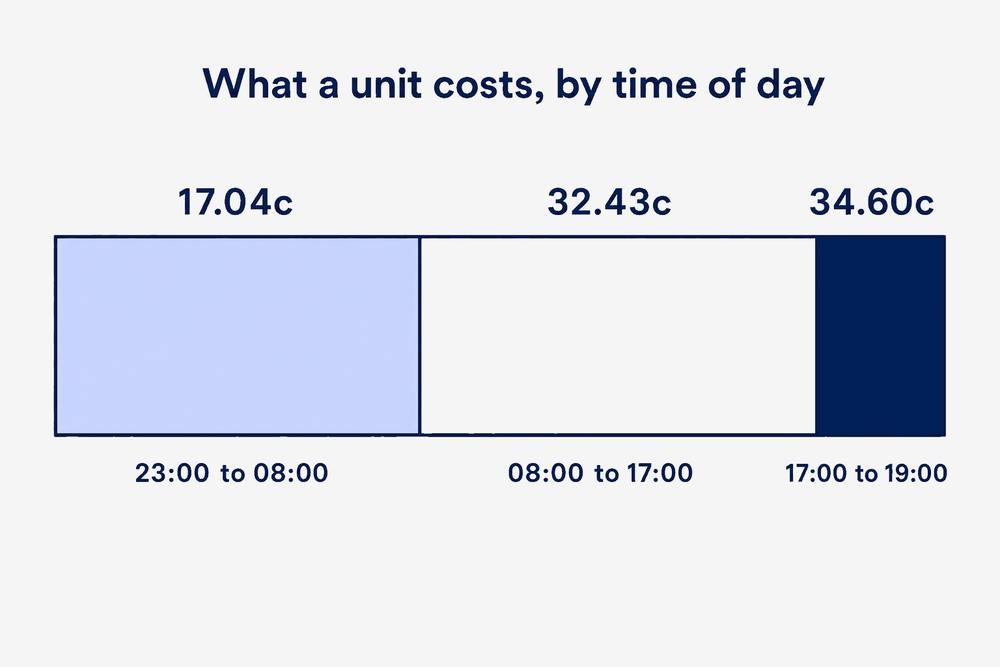
Smart, day: 32.43c/kWh, 08:00–17:00 and 19:00–23:00.
Smart, peak: 34.60c/kWh, 17:00–19:00.
Smart, night: 17.04c/kWh, 23:00–08:00.
The smart rates are Electric Ireland's published Home Electric+ rates. Discounts and plans change, so treat these as the shape of the thing rather than a quote.
Before you use a single unit of electricity, you pay a standing charge. On a standard or smart meter that runs from about €250.77 a year in an urban area to €314.98 in a rural one. On an older day/night meter it's higher again, roughly €328.58 urban and €400.48 rural.
Worth knowing for two reasons. A rural home starts every year about €64 behind an urban one before anything is switched on. And if you're on a day/night meter and not actually using the night rate, you're paying a premium standing charge for nothing.
Every figure below is worked the same way: energy used in kilowatt hours, multiplied by the unit rate. The assumptions are stated so you can change them.
0.49 kWh per eco cycle, 4 washes a week — 19c a wash.
€39/year · €17 at night rate
1.8 kWh per cycle, 3 loads a week — 68c a cycle.
€107/year · €48 at night rate
4.5 kWh per cycle, 3 loads a week — €1.71 a cycle.
€267/year · €120 at night rate
0.62 kWh per eco cycle, 5 runs a week — 24c a run.
€61/year · €28 at night rate
250 kWh a year, running constantly.
€95/year · it never switches off, so the night rate doesn't apply
0.35 kWh an hour, 6 hours a day for 5 months — 80c a day.
€122/season · €55 at night rate
1 kWh an hour, 4 hours a day for 6 weeks — €1.52 a day.
€64/summer · you use it when it's hot, so the night rate rarely applies
0.9 kWh an hour, 4 hours a week — 34c an hour.
€71/year
A 10 minute shower, once a day — 54c a shower.
€197/year · €88 at night rate
A 3 minute boil, 5 boils a day — 6c a boil.
€52/year
90W, 4 hours a day — 14c a day.
€50/year
A few things jump out of that table. The fridge freezer is the quiet one — it costs less per hour than almost anything else on the list and more per year than most of them, because it's the one appliance that never switches off. The shower is the surprise: an electric shower pulls more power than anything else in a normal house, and a daily 10 minute shower costs more over a year than a heat pump tumble dryer. And the gap between the two tumble dryers is enormous, which brings us to the comparison most people came here for.
A condenser dryer heats air, pushes it through the drum, and dumps the heat. A heat pump dryer recycles that heat instead, which is why it uses roughly a third of the electricity for the same load.
On the assumptions in the table above, that's about €160 a year. Over a ten year life, the difference in running cost is well past €1,000 at today's rates, and rates have gone one direction for a while.
The honest counterweight: heat pump dryers cost more up front and run longer per cycle, typically two to three hours against one to two. If you need a load turned around fast, that matters. If you tend to put a load on and forget about it, it doesn't.
What decides it here is the number of loads. Between 199 and 273 days a year see measurable rain, depending where in the country you are. Line drying is a smaller part of the year than people assume, so the dryer runs more, so the efficiency gap compounds faster.
The radiator is not free. Drying wet washing indoors puts several litres of water into the air of your house, which then has to be heated and ventilated back out, and it's the single most common cause of the condensation and mould that shows up on windows every autumn.
So the real comparison is between a dryer and a dehumidifier, and it depends on what you're asking for. A heat pump tumble dryer costs least per load and gets it into the wardrobe today. A dehumidifier is not really a drying appliance — it's a moisture-management appliance that happens to dry a rack of clothes overnight while also solving the damp problem in the room. Running a 20L dehumidifier for six hours costs about 80 cent at the day rate, comparable to one heat pump dryer cycle, but it dries a full rack rather than one drum, and it protects the room while it does it.
If you're drying indoors anyway, a dehumidifier is doing two jobs. If you're not, a dryer is doing one job faster. If damp and mould are the real issue, our damp and condensation guide goes into that in more depth.
The arithmetic is simpler than it looks, and the energy label gives you the number.
So an A-rated washing machine quoting 49 kWh per 100 cycles uses 0.49 kWh a wash, which is 18.6 cent, which over four washes a week is a little under €39 a year.
For anything without a label, the rating plate on the back gives you watts. Divide by 1,000 for kilowatts, multiply by hours used, multiply by your rate. A 3kW kettle boiling for three minutes uses 0.15 kWh, about 6 cent.
One caution about label figures. Label figures come from a standard test programme, usually the eco cycle. Real households use quick washes and 60 degree cottons, which use more. The label is ideal for comparing two machines against each other, which is what it's designed for. Treat it as a ranking, not a bill.
If you have a smart meter and a time-of-use plan, electricity between 23:00 and 08:00 costs roughly half what it costs during the day. Three appliances can move into that window without you doing anything differently, because all three have delay timers: the washing machine, the tumble dryer and the dishwasher.
On the assumptions above, shifting all three to the night rate saves in the region of €150 a year. That's more than the difference between most mid-range appliances and the efficient version of the same thing.
Two caveats worth being straight about. Some home insurance policies and most fire services advise against running a washing machine or tumble dryer unattended overnight, and that's a fair point rather than a technicality. Running the dishwasher overnight carries no such concern. And a time-of-use plan usually charges more during the day and at peak than a flat rate does, so it only pays if you genuinely move the load.
Every appliance we sell carries its energy label on the product page, so you can do the sum above before you commit. If the grade or the kWh figure isn't clear, our team can find it for you, seven days a week.
When your new appliance is delivered we take the old one away and recycle it free of charge under WEEE Ireland, as long as it's a like-for-like replacement and you let us know before delivery. Our appliance recycling guide covers what happens to it after that.
On Electric Ireland's standard rate of 38.04 cent per kWh, a heat pump dryer costs about 68 cent a cycle and a condenser about €1.71. For a household doing three loads a week that's roughly €107 a year against €267.
Per load of laundry, a heat pump tumble dryer usually costs less and is always faster. A dehumidifier costs about 80 cent for a six hour run, dries a full airer rather than a drum, and manages the moisture in the room at the same time. If you're drying indoors regardless, the dehumidifier is doing two jobs at once.
We had the highest household electricity price in the EU in the second half of 2025, at 40.42 cent per kWh including taxes against an EU average of 28.96 cent. A high dependence on imported gas for generation, network costs across a dispersed population, and the levies carried on the bill all contribute.
Only if you're on a smart or time-of-use plan. On a flat 24-hour rate the time of day makes no difference. On a smart plan, night units cost roughly half the day rate, and a delay timer on the washing machine, dryer and dishwasher is the easiest way to use that.
It's a fixed daily charge for being connected, currently in the region of €250 to €400 a year depending on your meter type and whether you're urban or rural. You can't avoid it, but if you're on an older day/night meter and never use the night rate, you're paying the higher version of it for no benefit.
Check the rating plate, usually on the back or inside the door, for a wattage. Divide by 1,000 to get kilowatts, multiply by the hours you run it, and multiply by your unit rate. A plug-in energy monitor gives you the real figure if you want to be exact.
