
My Account

Track Order Trade Enquiries

Your Basket

Prices you'll love!
always the best deals
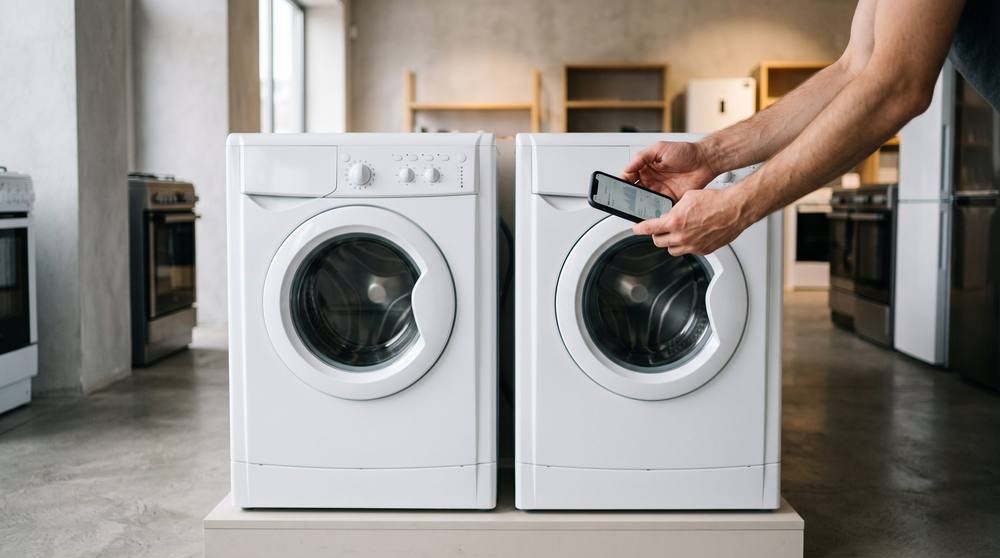
Two washing machines side by side in a showroom, with a person holding a phone up as if comparing them.

How to Read an Energy Label

The letter is a band. The numbers underneath are what actually cost you money.
Why it's worth reading properly

We pay the highest household electricity price in the European Union, at 40.42 cent per kilowatt hour including taxes in the second half of 2025, against an EU average of 28.96 cent. That makes the consumption figure on the label worth more here than anywhere else in Europe. The same difference between two fridge freezers costs a household here roughly 40% more over the life of the appliance than it costs the average European household. The label is the only comparable, standardised, tested number you get.

Make sure it's the right label

Worth clearing up first, because it causes real confusion when people shop across borders.

We use the EU energy label. Britain, since leaving the EU, uses its own version, which looks similar and is not the same. Displaying the British energy label to consumers here is prohibited under Regulation (EU) 2017/1369, and SEAI carries out energy label market surveillance on behalf of the market surveillance authority.

The practical tell is the QR code. An EU label carries one in the top right that links to EPREL, the European Product Registry for Energy Labelling. The British label does not.

The rescale, and why your old fridge was an A+++

Until 2021 the scale ran from A+++ down to D. Manufacturers got so good at meeting the top grades that almost everything on sale was an A+ or better, and the label stopped telling anybody anything.

So it was rescaled back to a clean A to G, and the bar was raised deliberately. An appliance that was an A+++ under the old scale typically lands around B or C under the new one. Nothing got worse. The ruler changed.

A is deliberately hard to reach, and on some product categories almost nothing achieves it — by design, so the scale stays useful as technology moves on. A B-rated washing machine in 2026 is genuinely efficient, and a C is perfectly respectable.

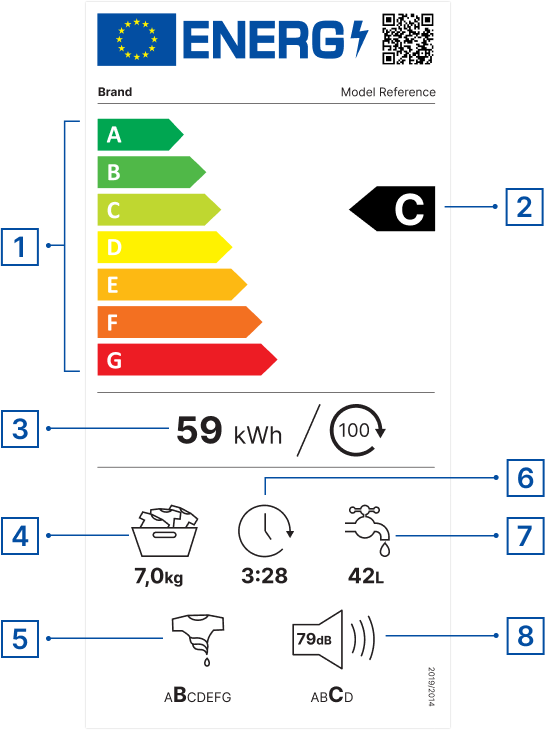
The parts of an EU energy label explained: the A to G scale, the QR code linking to EPREL, the kWh consumption figure and the pictogram row.

Official EU energy label artwork, European Commission.

What each part tells you

The layout is standard across product groups, which is the whole point of it.

  • The QR code, top right. Scan it and you land on that exact model's entry in EPREL, the EU product database — more detail than fits on the label, including the full technical datasheet. The single most underused thing on the label.
  • The letter and the arrow. Your band, A to G. Useful for a first pass, not for a final decision.
  • The big number underneath, in kWh. This is the one that matters. Depending on the product group it's either energy per year or energy per 100 cycles.
  • The pictograms along the bottom. These change by product group and are more useful than they look.
  • Noise, in decibels with a class from A to D. Genuinely important in an open-plan kitchen or an apartment — the thing people most often wish they'd checked.

What the kWh figure means, by product group

Fridges, freezers, wine coolers

kWh per year. Check fridge and freezer volumes separately, plus noise and noise class.

Washing machines and washer dryers

kWh per 100 cycles. Check capacity, water per cycle, duration, spin-drying class A to G.

Dishwashers

kWh per 100 cycles. Check place settings, water per cycle, duration, drying class.

Tumble dryers

kWh per 100 cycles. Check capacity, duration, condensation efficiency class, noise.

Televisions

kWh per 1,000 hours, given separately for standard and high dynamic range.

Ovens

kWh per cycle. Check cavity volume.

The letter is a band. The number is the number.

This is the single most useful habit to take from this page.
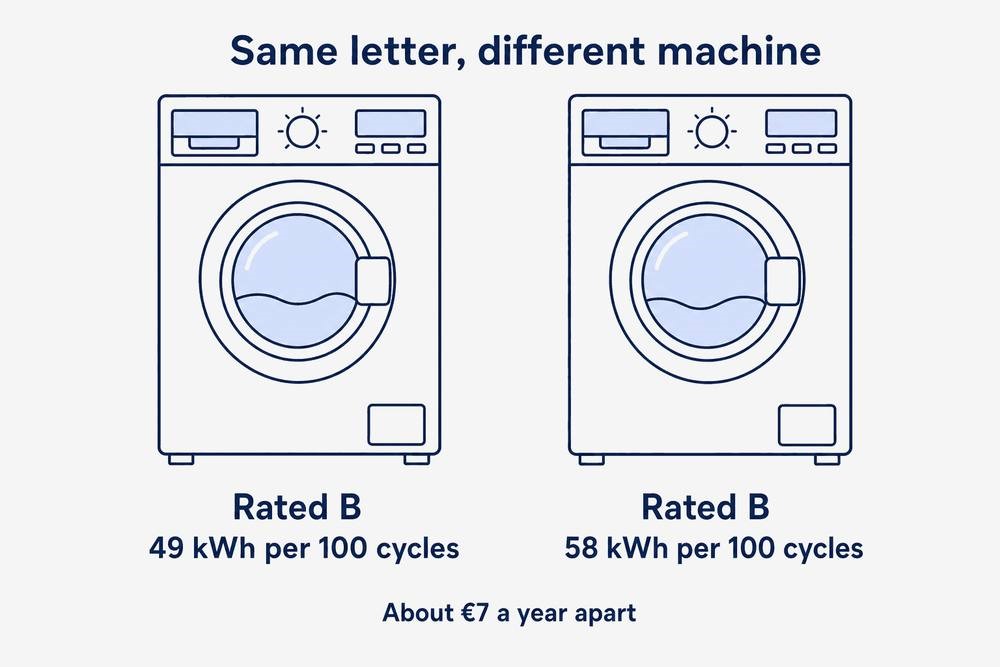
Two washing machines both rated B, one using 49 kWh per 100 cycles and the other 58, about seven euro a year apart.

Two washing machines can both be B-rated and differ in consumption, because a grade covers a range. If one quotes 49 kWh per 100 cycles and the other quotes 58, they may share a letter, and at four washes a week and 38.04 cent per kWh the second one costs you about €7 a year more. Over a decade that is a real number, and it's invisible if you only read the letter.

So: filter by letter to build a shortlist, then compare the kWh figures within the shortlist.

One honest caveat about test figures. Label figures come from a standardised test on the eco programme. Households use quick washes and hotter cycles, so real consumption runs higher than the label for nearly everybody. That doesn't make the label misleading. It makes it a fair comparison rather than a prediction, which is exactly what it's for.

Turning the label into euro

  1. Take the kWh figure and convert it to your usage. A washing machine quoting 49 kWh per 100 cycles uses 0.49 kWh per wash. At four washes a week that's about 102 kWh a year.
  2. Multiply by your unit rate. At Electric Ireland's standard 38.04 cent per kWh, that's about €39 a year.
  3. Multiply by how long you'll own it. Eight to ten years is a reasonable working life for a major appliance.

Do that for both machines you're choosing between and the difference in running cost is often larger than the difference in price.

What changed recently, and what's coming

Tumble dryers, from 1 July 2025

New ecodesign and labelling rules under Regulations (EU) 2023/2533 and 2023/2534 brought household tumble dryers onto the A to G scale and set minimum requirements: an energy efficiency index of no more than 85, and a condensation efficiency of at least 80% for condenser dryers. The rules also added requirements on spare parts availability and low-power modes. Old blue-border labels had to be replaced with the new ones in the first half of July 2025. If you're comparing a dryer bought before that against one on sale now, the labels aren't comparable.

A reparability score on tumble dryers, from 1 January 2027

A repairability index becomes mandatory on the energy label for household tumble dryers placed on the market from 1 January 2027, under Delegated Regulation (EU) 2025/1353. Smartphones and tablets have carried an equivalent scale since June 2025. This is a meaningful shift in what the label is for: until now it has rated how much energy a product uses, and from 2027 it starts rating how long the product can be kept alive.

Reading the label when you're buying from us

Every appliance on our site carries its energy label and the declared consumption figures on the product page, so you can do the arithmetic above before you commit. If the figure you want isn't obvious, our team can find it for you, seven days a week.

Shop our range »

Talk to our team

FAQs

The scale was rescaled to a clean A to G because nearly everything on sale had reached A+ or better and the label had stopped distinguishing between products. An old A+++ appliance typically sits around B or C on the new scale. The product didn't change, the scale did.

Because the top of the scale was deliberately left almost empty so it stays useful as technology moves on. On some product groups very little achieves an A today. A B-rated washing machine in 2026 is an efficient machine.

No. Displaying the British energy label to consumers here is prohibited under Regulation (EU) 2017/1369, and SEAI carries out market surveillance on energy labelling. The easy way to tell them apart is the QR code, which appears on the EU label and not the British one.

It links to that specific model's entry in EPREL, the European Product Registry for Energy Labelling, which holds the full technical datasheet. It's more detailed than the label itself and worth scanning before you buy.

No, and it isn't meant to be. It comes from a standard test on the eco programme, so real household use runs higher. Every product is tested identically, so the comparison between two appliances holds even though the absolute figure won't match your bill.

From 1 January 2027 household tumble dryers placed on the market must carry a repairability index on the energy label. Smartphones and tablets have carried a similar scale since June 2025. It rates how easily a product can be repaired rather than how much energy it uses.

Recently viewed


Back to top
